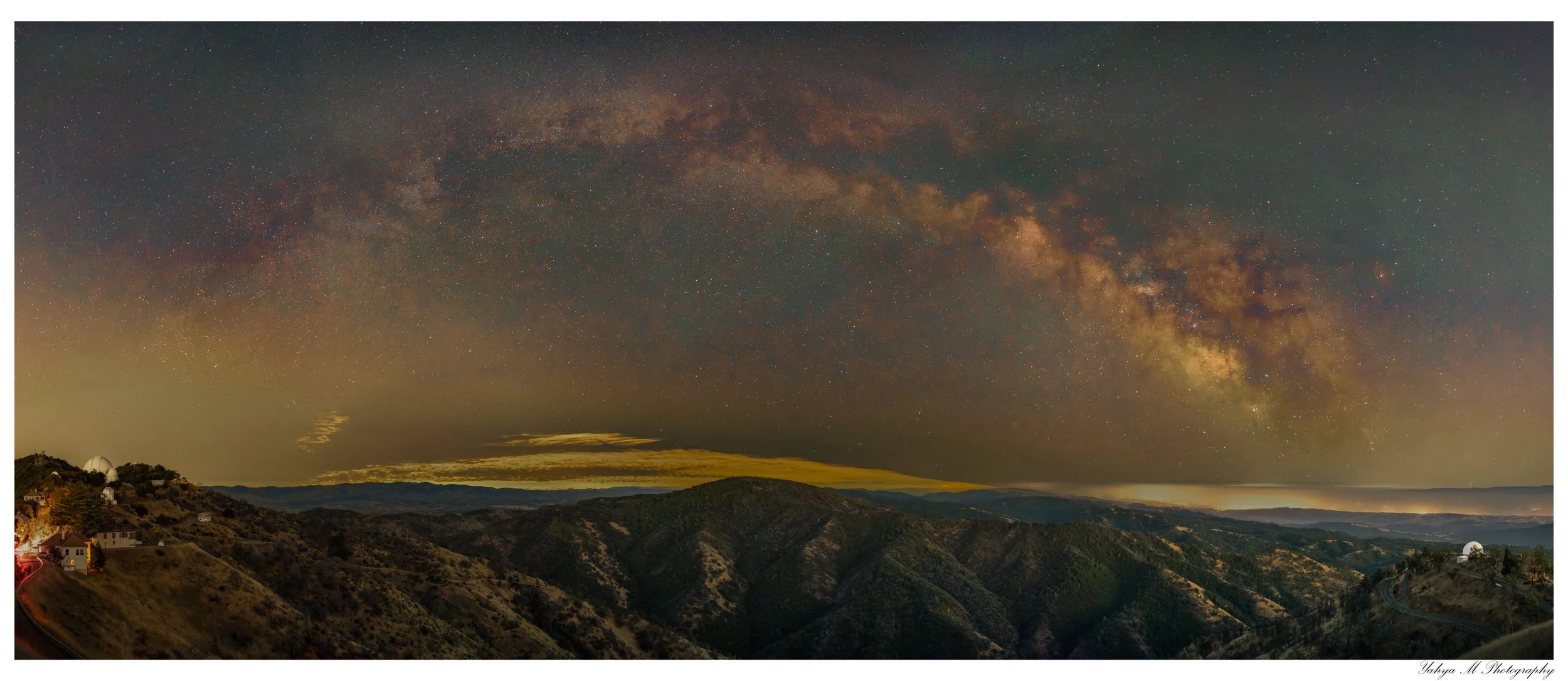
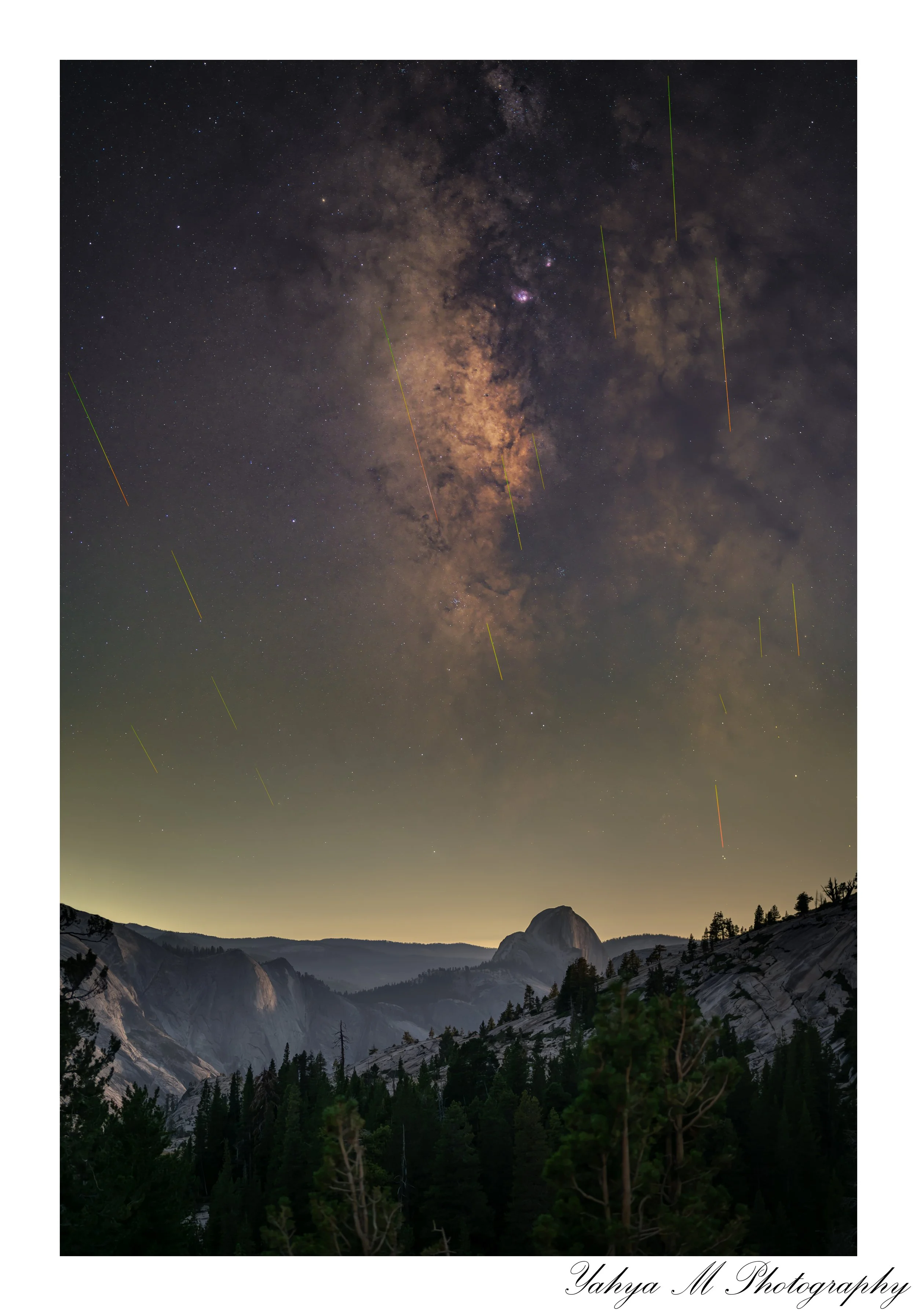
I once read an article that said when Los Angeles was hit with a massive power outage in 1994, residents called 911 to report strange gases glowing in the sky*! What they were seeing was the milky way indeed! It hit me then, if you have lived in a large city all your life and have not had the chance to go explore outdoors in an absolutely dark environment, what will be your impression of the Milky Way? I guess pretty similar to what happened to the people in LA in 1994.
*https://timeline.com/los-angeles-light-pollution-ebd60d5acd43
When it comes to the milky way photography, there are a few things that I need to mention. First, stars are not very bright. Their brightness level is 1/100th to 1/1000th of a full-moon brightness. Our eyes use cones to see during the day (when it is too bright) and use rods to see during nights (when it is too dark). Cones are very sensitive to colors while rods mostly help us see as black and white. Thus, at nights, we do not see a specific color for stars since they are too dim. When we use a camera to take a photo of stars, we generally make the sensor collect light for a long time, i.e., 20 seconds. What this means is that a camera can add up all the emitted light by stars (called integration). But our eyes are not integrators, they see spontaneously. This results in a camera recording a surprisingly bright image that you will never see with your eyes. Second, postprocessing that happens on the photos is able to bring out more detail out of the photo than the un-edited photos show us. The fact that we cannot see the milky way with our eyes as vividly as cameras makes it hard for us to know how much editing has been done on a photo. So, when we see a heavily edited version of the milky way, we get overjoyed and shocked, and also appreciative of the photographer’s amazing work. In general, we as humans, like surprises! On my website, I have milky way photos that I have not edited much, have edited a bit, or edited a little more than I generally do. The milky way photos that I have edited the most are the photos that I have taken with a lens with a long focal length, since these lenses give us an incredible close-up view of the Milky Way, like a telescope. The easiest metric to know if a photo is edited heavily or not is to look at the photo’s histogram. If the balance between yellow and blue, and magenta and tint is not correct, it means that white will not look white on that image. So, that photo is edited with an artistic flavor.

Eta Aquariids meteor shower as seen from the Figueroa mountain, CA. The milky way core can easily be seen in the photo. Some of the stars look bloomed out. This was mainly because of the low clouds that you can see at the bottom left of the image that stretched all the way to the bottom right. I was very worried about these clouds when I examined the sky around 10 pm, but the sky got pretty clear around 1 am with only some clouds stretching across. And then the show began. Shooting stars crossing the night sky right before my eyes. A stunning show complemented by the Milky Way core in mid May. I think I saw 12 shooting stars that night with naked eyes. The most I had ever seen in my life!

Planet conjunction seen from the top of the La Cumbre peak in CA. Not only these five planets were aligned, but also the moon tried to get in between the planets, causing a multi-body planetary parade that will not happen for another 30 years! Santa Barbara is covered in a thick fog and the famous Channel Islands are seen at the very far (bottom right of the photo). I hope I am alive when this show happens again in 30 years.
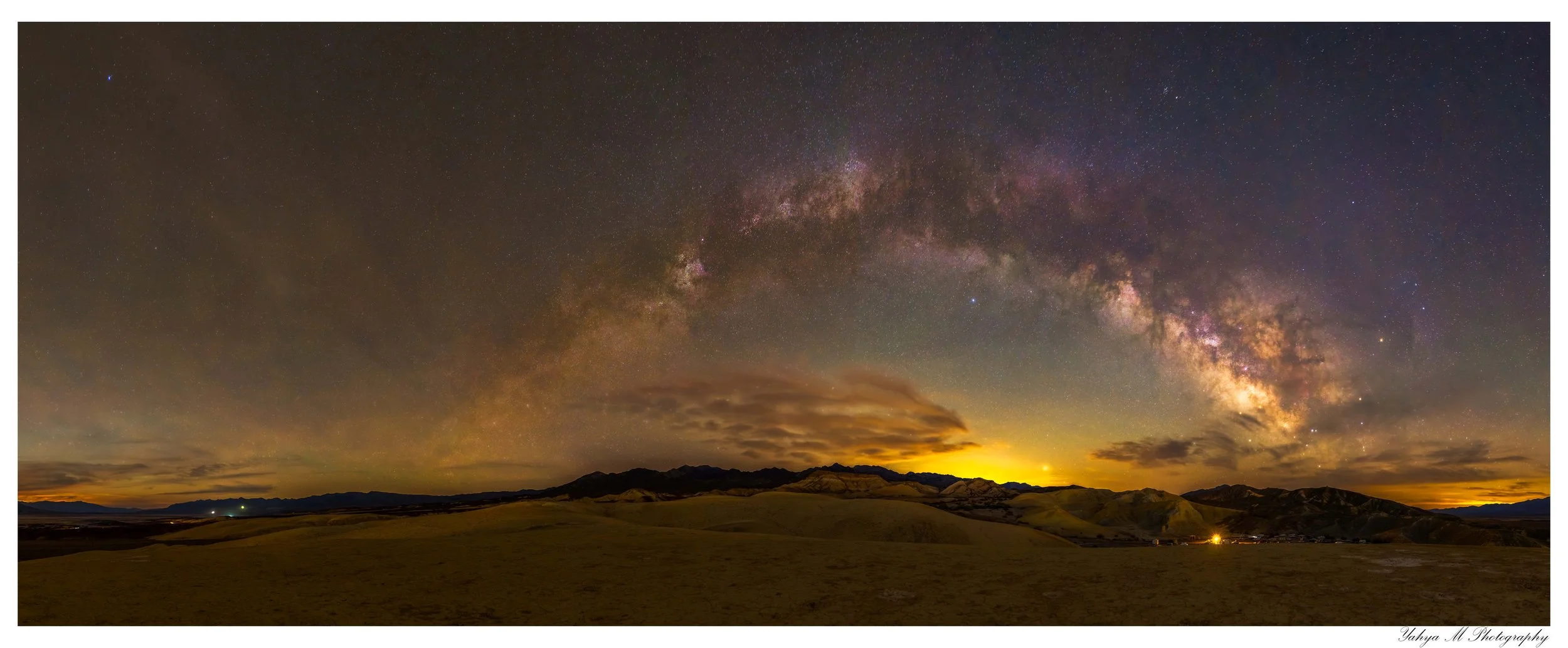
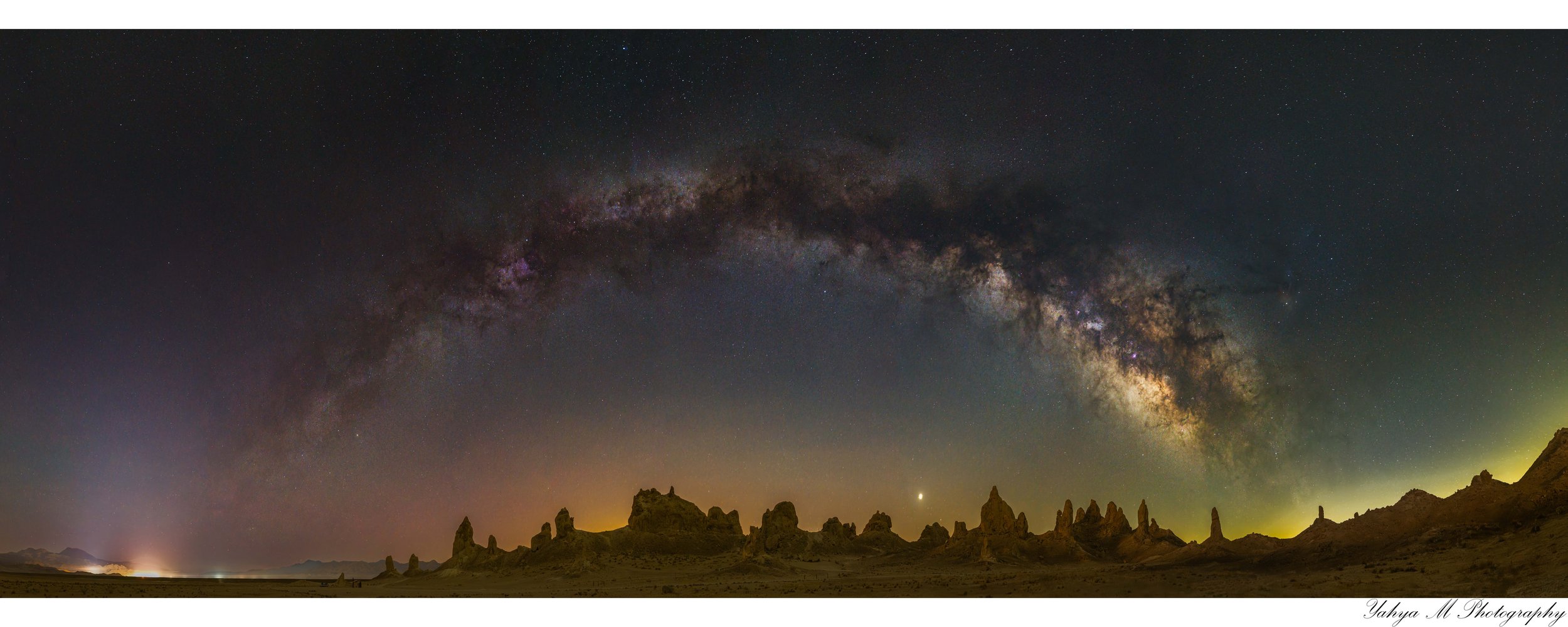

My goodness! This photo had me thinking for days. I was trying to take a panorama of the Milky Way at Trona Pinnacles but time got tight and half way through the shots, the astronomical twilight kicked in. Basically, when astronomical twilight kicks in, sky is too bright for an astrophoto and only the brightest of stars can be observed. when this happened, I got so frustrated but still kept capturing my photo sequence. When I stitched the photos together to make my panorama, I saw this beautiful color transition from red to blue that I had never seen before. The moral of the story is to never give up and trust the process!

Milky way panorama, with Lyrids meteor shower superimposed on top of it, at Santa Margarita lake, CA. Lyrids is one of the weakest meteor showers of the year and I think at the peak, there will be around 20 meteors per hour over the entire sky. So, you can basically see much less than that because of the limited field of view of your eye. I started my stargazing around 1 AM and saw about 15 meteors until around 5 AM. Still, that is a very good rate to see some meteors in the night sky. For this photo, I set up my camera on top of my panorama head and started taking shots at f/2.0, ISO of 1000, and an exposure time of 20 seconds. I took 10 shots per scene to reduce the noise by photo stacking. This whole panorama is made up of 11 stacked photos (thus a total of 11x10=110 photos). Once I stitched the photos in postprocessing, I then looked at my individual photos and tried to find the photos that had meteors in them. All I could find were 5 meteors that you can see in this photo. What happened to the other 10 meteors? They were outside the field of view of the camera. I could move my head around very easily but could not do that with a camera! Amazing how advanced our body is, yet we keep ignoring it to a great degree. More surprising to me, however, was that I did not see the green meteor in this image with my own eyes as I was looking at different directions, but my camera captured it. It was absolutely amazing to see a green meteor in the photo, in fact the first time I saw a green meteor. Remember that meteors will appear with different colors depending on the material they are made of and the type of air they are passing through. I think a green meteor shows an abundance of Magnesium. I tried my best to make sure the white balance on this photo is close to reality but I had to change it a bit because the light pollution over at the horizon was really killing the beauty of the photo. One last note, if you look at the bottom left of the image, right on top of the tree next to the light pollution, you can see the Andromeda Galaxy (it appears as a small bright circle with concentric rings around it). Remember that this galaxy is the nearest galaxy to the milky way, yet it is 2.5 million light-years away!!! Isn’t that mind boggling?

Milky way transition through the nigh sky as night ends and astronomical twilight begins at Santa Margarita Lake, CA. I always love these milky way color transitions that happen in a very short span of time. As a reference, the photo on the very left was taken at 4:53 AM and the photo on the very right was taken at 5:06 AM. From this camping/astrophotography trip, I started taking milky way photos at an ISO of 1000 instead of 3200 or higher. This helped me get better color variation across my images as opposed to getting shots at an ISO of 3200 that makes most of the stars look white. If your camera has some degree of ISO invariance, that is the range within which your image quality is not going to degrade too much, you can lower your ISO and then compensate the darkness by increasing the exposure in post processing later. Low ISO photography brings a whole level of color gamut to the image that I quite like. I don’t mind trailing stars in the image of a milky way, so I kept the same exposure time of 20 seconds. I stacked 10 photos for better image quality and reduced noise level and am quite pleased with the results. I do not change the camera settings while taking these shots because my goal is to capture the milky way. This is why colors can look saturated on the photos to the right. Essentially those photos are overblown! For a panorama of milky way with the Andromeda galaxy and meteors in it, please look at the photo below.